

Sommaire
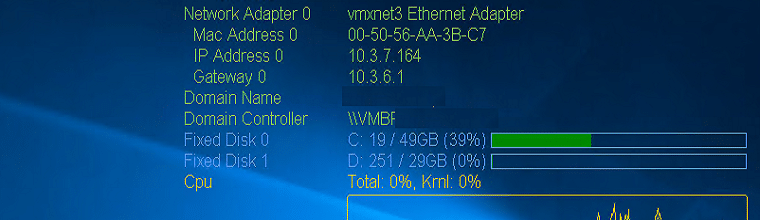
Desktop Info affiche des informations à propos de votre système en temps réel directement sur votre écran. Cette application est entièrement paramétrable via son fichier de configuration, il vous sera possible de régler les informations affichées, régler la position de l’affichage, régler les couleurs d’affichage et etc…
L’application est autonome et ne nécessite aucune installation sur votre système, il vous suffit d’exécuter le programme pour lancer le processus. Il est également bien de souligner que cette application ne consomme que très peu de ressource système et fonctionnera donc parfaitement dans tous vos environnements.
Un peu plus d’informations concernant Desktop Info : http://www.glenn.delahoy.com/software/
Téléchargement des sources
Les sources sont disponibles via le site internet officiel ici même : http://www.glenn.delahoy.com/software/
Plusieurs fichiers seront présents :
- DesktopInfo.exe : Il s’agit de l’application exécutable.
- desktopinfo.ini : Il s’agit du fichier de configuration, nous reviendrons plus tard dessus
- readme.txt : Il s’agit d’un fichier d’aide.

Copiez ces fichiers dans un partage, nous les utiliserons par la suite avec le script.
Configuration de l’application
Editez le fichier « desktopinfo.ini ».
Pour chaque catégorie, vous pourrez configurer :
- L’activation ou non de l’affichage
- L’intervalle de rafraîchissement
- La couleur d’affichage
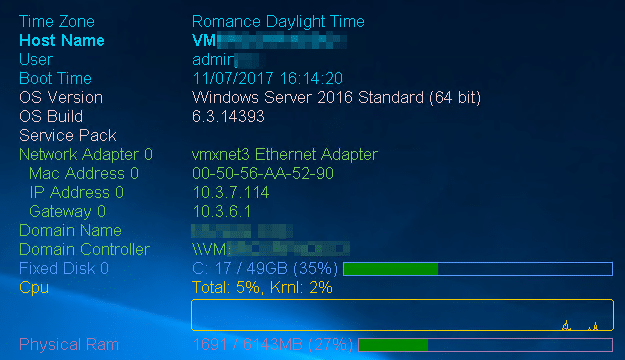
Voici un exemple de mon fichier de configuration (CF image ci-dessus pour l’exemple) :
[options]
top=15
#left=5
#bottom=40
right=15
width=600
fontface=Arial
fontsize=13
cleartype=0
ssfontsize=17
formcolor=000000
contextmenu=1
allowdrag=0
offset=1
#language=english.ini
msnstatus=0
inimonitortime=10
#log=desktopinfo.log

[items]
# date / time
COMMENT=active:0,interval:0,color:aaaaaa,style:biu,text:Desktop Info
DATETIME=active:0,interval:1,color:EECC00
TIMEZONE=active:1,interval:60,color:EECC00
HOST=active:1,interval:0,color:EECC00,style:b
USER=active:1,interval:0,color:EECC00
BOOTTIME=active:1,interval:0,color:EECC00
UPTIME=active:0,interval:1,color:EECC00

# hardware
COMMENT=active:0,interval:0,color:aaaaaa,style:i,text:Hardware
OEMINFO=active:0,interval:0,color:0099EE
CPUTYPE=active:0,interval:0,color:0099EE
CPUCOUNT=active:0,interval:0,color:0099EE
CPUTEMP=active:0,interval:10,color:00CCEE
BATTERY=active:0,interval:60,color:00CCEE,chart:1
MOTHERBOARD=active:0,interval:0,color:0099EE
BIOS=active:0,interval:0,color:0099EE
DISPLAYCONTROLLER=active:0,interval:0,color:0099EE
AUDIOCONTROLLER=active:0,interval:0,color:0099ee
SERIALNUMBER=active:0,interval:0,color:0099ee

# windows configuration
COMMENT=active:0,interval:0,color:aaaaaa,text:Windows Configuration
OSVERSION=active:1,interval:0,color:CCCCEE
OSBUILD=active:1,interval:0,color:CCCCEE
SERVICEPACK=active:1,interval:0,color:CCCCEE
IEVERSION=active:0,interval:0,color:CCCCEE
DIRECTX=active:0,interval:0,color:CCCCEE
SCREEN=active:0,interval:120,color:CCCCEE

# network adapters
COMMENT=active:0,interval:0,color:aaaaaa,text:Network Adapters
NETWORKADAPTER=active:1,interval:30,color:55CC77,activeonly:1,count:8,filter:
IPADDRESS=active:1,interval:30,color:55CC77,offset=1
MACADDRESS=active:1,interval:60,color:55CC77,offset=1
GATEWAY=active:1,interval:30,color:55CC77,offset=1
DHCPSERVER=active:0,interval:30,color:55CC77,offset=1
WINSSERVER=active:0,interval:30,color:55CC77,offset=1
# network stack
COMMENT=active:0,interval:0,color:aaaaaa,text:Network Stack
DNSSERVER=active:0,interval:30,color:55CC77
LEASEEXPIRY=active:0,interval:30,color:55CC77
PROXY=active:0,interval:60,color:55cc77
DOMAIN=active:1,interval:30,color:55CC77
DOMAINCONTROLLER=active:1,interval:30,color:55CC77
WORKGROUP=active:0,interval:30,color:55CC77
NETCONNECTIONS=active:0,interval:10,color:55CC77,chart:0,threshold:150,tcolor:0000FF
NETPACKETS=active:0,interval:10,color:55CC77
NETPACKETSRATE=active:0,interval:10,color:55CC77,chart:2,threshold:500,tcolor:0000FF

# disks
COMMENT=active:0,interval:0,color:aaaaaa,text:
FIXEDDISK=active:1,interval:10,color:FF9955,chart:1,threshold:90,tcolor:0000FF,count:8,shortdisplay:1,filter:
DISKIO=active:0,interval:10,color:FF9955,chart:0,threshold:10000,tcolor:0000FF

# processes
COMMENT=active:0,interval:0,color:aaaaaa,text:Processes
CPU=active:1,interval:5,color:00CCEE,chart:2,threshold:95,tcolor:0000FF
CPUUSAGE=active:0,interval:5,color:00CCEE,chart:2,threshold:95,tcolor:0000FF,count:8
PROCESSCOUNT=active:0,interval:5,color:00CCEE,chart:0,threshold:100,tcolor:0000FF
TOPPROCESSCPU=active:0,interval:5,color:00CCEE,chart:0,threshold:95,tcolor:0000FF
TOPPROCESSMEM=active:0,interval:5,color:00CCEE,chart:0,threshold:500,tcolor:0000FF
TOPPROCESSPF=active:0,interval:5,color:00CCEE,chart:0,threshold:5000,tcolor:0000FF

# memory
COMMENT=active:0,interval:0,color:aaaaaa,text:Memory
PHYSICALRAM=active:1,interval:5,color:AA77AA,chart:1,threshold:90,tcolor:0000FF,shortdisplay:1
VIRTUALMEMORY=active:0,interval:5,color:AA77AA,chart:0,threshold:90,tcolor:0000FF,shortdisplay:1
PAGEFILE=active:0,interval:5,color:AA77AA,chart:0,threshold:90,tcolor:0000FF,shortdisplay:1
PAGEFAULTS=active:0,interval:5,color:AA77AA,chart:0,threshold:5000,tcolor:0000FF

# printers
COMMENT=active:0,interval:0,color:aaaaaa,text:Printers
PRINTER=active:0,interval:60,color:888888,count:8
PRINTERSTATUS=active:0,interval:60,color:888888
DEFAULTPRINTER=active:0,interval:60,color:888888
# misc
COMMENT=active:0,interval:0,color:aaaaaa,style:iu,text:Miscellaneous - Testing
FILE=active:0,interval:10,color:ff8888,type:text,text:Setup,file:
REGISTRY=active:0,interval:10,color:ff8888,tree:0,text:Run Key,key:HKEY_CURRENT_USER\Software\Microsoft\Windows\CurrentVersion\Run\
EVENTLOG=active:0,interval:10,color:ff8888,text:System Events,log:System
TSSESSIONS=active:0,interval:10,color:888888
UNREADMAIL=active:0,interval:60,color:888888,chart:0,threshold:10,tcolor:0000FF
ENVVAR=active:0,interval:60,color:888888,text:Logon Server,key:logonserver
LOGONSESSION=active:0,interval:60,color:888888
Scripting et déploiement
Nous allons maintenant nous attarder sur le scripting et le déploiement automatique de Desktop Info. Le but étant d’automatiser le lancement de l’application lorsque vous ouvrez une nouvelle session sur un serveur.
Le script sera effectué en Powershell et nous automatiserons le déploiement par une GPO.
Scripting
Voici le script que je vous propose, il fonctionne comme cela :
- Copie en local des sources (écrase le fichier de configuration .ini à chaque ouverture de session)
- Exécution de Desktop Info en local
Note : N’oubliez pas de modifier et adapter les variables du scripts à votre environnement (CF bloc « Variables » 🙂 ).
#########################################################################################
#
# (c) Copyright 2017 - Jérémy LEBON - sys-advisor.com
#
# This program is free software: you can redistribute it and/or modify
# it under the terms of the GNU General Public License as published by
# the Free Software Foundation, either version 3 of the License, or
# (at your option) any later version.
#
# This program is distributed in the hope that it will be useful,
# but WITHOUT ANY WARRANTY; without even the implied warranty of
# MERCHANTABILITY or FITNESS FOR A PARTICULAR PURPOSE.  See the
# GNU General Public License for more details.
#
# You should have received a copy of the GNU General Public License
# along with this program. If not, see http://www.gnu.org/licenses/.
#
#########################################################################################

# ---------------------------------------------------------------------------------------
# Script  :  Deploy_DesktopInfo.ps1
# Objet   :  Main Script
# Author  :  Jérémy LEBON, sys-advisor.com
# Version :  1.2
# Date    :  29/09/2017
# ---------------------------------------------------------------------------------------

#########################################################################################
###### VARIABLES
#########################################################################################

#Local computer/server folder created for DesktopInfo
$DesktopInfoLocalPath = "C:\Exploit\DesktopInfo\"
#Path where you keep DesktopInfo
$DesktopInfoSourcePath = "\\SourcePath\"
#DesktopInfo.exe => Default Name
$DesktopInfoExe = "DesktopInfo.exe"
#DesktopInfo.ini => Default Name
$DesktopInfoIniPath = "DesktopInfo.ini"

$DesktopInfoExePath = $DesktopInfoSourcePath + $DesktopInfoExe #DesktoInfo.exe path
$DesktopInfoIniPath = $DesktopInfoSourcePath + $DesktopInfoIniPath #DesktoInfo.ini path
$DesktopInfoLocalExePath = $DesktopInfoLocalPath + $DesktopInfoExe #DesktoInfo.exe Local Path

#########################################################################################

#Check if folder exist
if (-NOT (Test-Path $DesktopInfoLocalPath)) {
    New-Item -ItemType Directory c:\Exploit\DesktopInfo #Create folder
    Copy-Item $DesktopInfoExePath -Destination $DesktopInfoLocalPath #Copy DesktopInfo.exe
    Copy-Item $DesktopInfoIniPath -Destination $DesktopInfoLocalPath #Copy DesktopInfo.ini

}
else {
    if (-NOT (Test-Path $DesktopInfoLocalExePath)) {
        Copy-Item $DesktopInfoExePath -Destination $DesktopInfoLocalPath #Copy DesktopInfo.exe
    }

        Copy-Item $DesktopInfoIniPath -Force -Destination $DesktopInfoLocalPath #Force Copy DesktopInfo.ini
}

$Command = $DesktopInfoLocalExePath
$Argument1 = "/ini=$DesktopInfoIniPath"

& $Command $Argument1
Déploiement GPO
Créez une nouvelle GPO puis éditez la.
Rendez-vous dans :
- User Configuration
- Windows Settings
- Scripts (Logon/Logoff)
- Logon
- Scripts (Logon/Logoff)
- Windows Settings

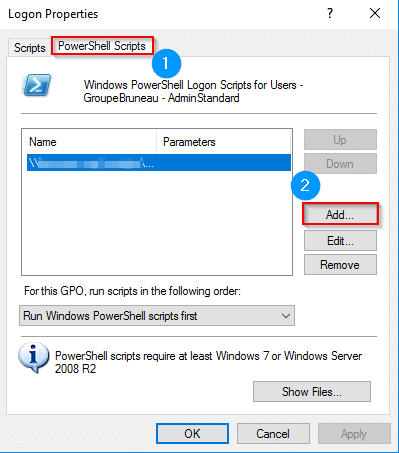
Cliquez sur l’onglet « PowerShell Scripts » puis cliquez sur « Add… » pour ajouter le script que nous venons de créer.
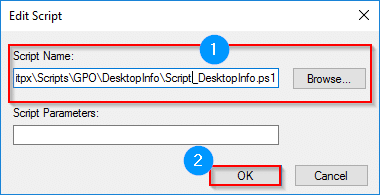
Ajoutez le script via « Browse… » sans saisir de paramètres puis cliquez sur « OK »
Si vous avez tout correctement configuré, alors l’application Desktop Info devrait automatiquement se lancer à chaque ouverture de session.






Hello there! I know this is kinda off topic however I’d figured I’d ask.
Would you be interested in exchanging links or maybe guest authoring a blog post or
vice-versa? My site covers a lot of the same topics as yours and I think
we could greatly benefit from each other. If you’re interested feel
free to shoot me an email. I look forward to hearing from you!
Wonderful blog by the way!
my webpage ultimateshop vc
https://love-hindi.com/brother-shayari/
We are a group of volunteers and opening a new
scheme in our community. Your site provided us with valuable information to work on.
You have done a formidable job and our whole community will be
thankful to you.
Review my website – abuse-shayari
https://love-hindi.com/brother-shayari/
We are a group of volunteers and opening a new
scheme in our community. Your site provided us with valuable information to work on.
You have done a formidable job and our whole community will be
thankful to you.
Review my website – abuse-shayari
https://love-hindi.com/brother-shayari/
We are a group of volunteers and opening a new
scheme in our community. Your site provided us with valuable information to work on.
You have done a formidable job and our whole community will be
thankful to you.
Review my website – abuse-shayari
https://love-hindi.com/brother-shayari/
We are a group of volunteers and opening a new
scheme in our community. Your site provided us with valuable information to work on.
You have done a formidable job and our whole community will be
thankful to you.
Review my website – abuse-shayari
When some one searches for his necessary thing, so he/she
desires to be available that in detail, therefore that thing is maintained over here.
My web blog; ultimateshop vc
When some one searches for his necessary thing, so he/she
desires to be available that in detail, therefore that thing is maintained over here.
My web blog; ultimateshop vc
Український сегмент мережі Інтернет отримав свіжий тематичний проєкт — збірку інтернет-ресурсів, створений для агрегації різнопланові веб-ресурси країни.
Цей інтернет-майданчик акумулює адреси веб-сторінок, що присвячені широкий спектр тем. У переліку представлені сайти загальнодержавного значення, так само, як і ті, що спеціалізуються на висвітленні подій певних областей.
Місія проєкту — створити зручну точку входу для інтернет-аудиторії, які шукають актуальні місцеві медіа на різний інтерес: як-от оперативні новини чи політичне життя до історичних розвідок, молодіжної тематики, стилю життя, громадської діяльності та експертних думок.
Каталог розрахований на масового відвідувача та запрошує до партнерства з медіа, журналістами та бізнес-партнерами, які бажають заявити про себе в інформаційному просторі України
Mods for Gorilla Tag are widely used because they add
new features.
Many players use mods to try new features, especially outside public matches.
A number of mods change movement mechanics, while others
focus on visuals.
There are also utility mods that make things easier.
Popular mod menus are commonly used because they combine different mods
into one interface.
Not all mod menus are the same, so choices vary by user.
It’s important to use mods responsibly, and only in private rooms.
Misusing mods can lead to bans.
The Gorilla Tag modding community is growing over time,
with new mods being released regularly.
Independent developers update their mods to fix bugs.
With each new game update, mods may require fixes, so staying
informed is important.
Overall, mods expand options for curious players, when used
as intended.
Mods for Gorilla Tag are really interesting because they expand gameplay.
Some Gorilla Tag players use mods to try new features, especially in private lobbies.
A number of mods change movement mechanics, while some improve graphics.
Some mods are quality-of-life focused that add helpful tools.
Popular mod menus are often mentioned because they include several tools into one interface.
Different menus offer different features, so players usually choose based
on preference.
Using mods requires caution, and only in permitted environments.
Using mods incorrectly can lead to bans.
The Gorilla Tag modding community is active, with
updated tools being released regularly.
Many creators update their mods to add features.
When Gorilla Tag receives updates, some mods break, so staying informed is important.
In general, mods increase replayability for
curious players, when used correctly.
Bonjour,
J’apprécie votre travail et vous remercie pour ce partage de connaissances.
Je scripte en Powershell et utilise cette solution. Par contre, n’ayant pas accès aux GPO, serait-il possible de personnaliser l’édition de Desktop info en fonction de mon script ? notamment pour afficher le S/N de mes deux écrans récupérés dans mon script ? pour le moment, les donnees sont récupérés dans un fichier texte.